
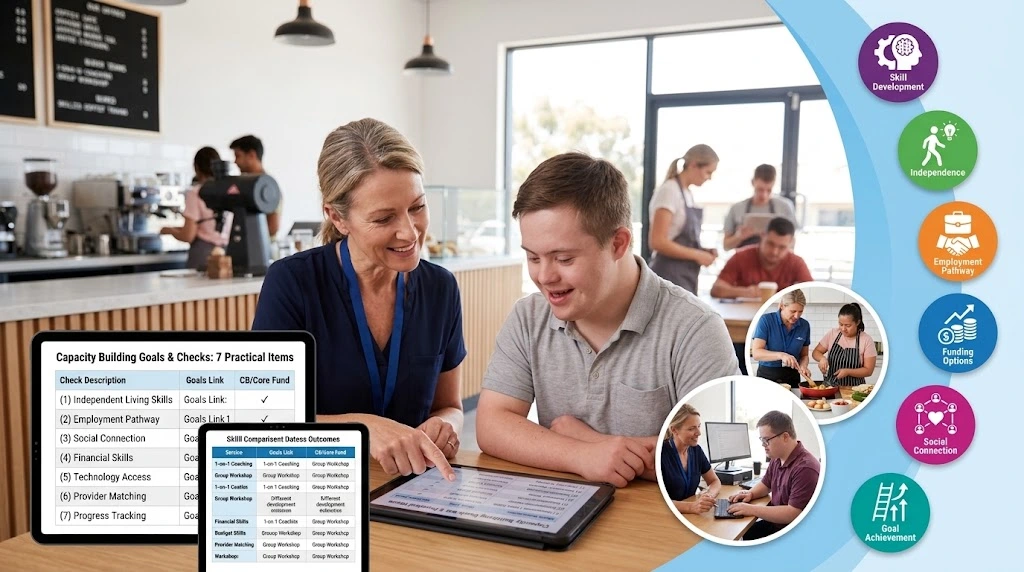
When researching capacity building NDIS Sydney services, it helps to understand how the National Disability Insurance Scheme (NDIS) can support you in developing practical skills, working towards personal goals, and becoming more independent.
Capacity building supports a focus on developing abilities that help you manage aspects of everyday life. Depending on your plan, this may include therapy, support coordination, employment-related assistance, social skills development, and training for daily living.
However, capacity building NDIS funding follows specific rules. Core supports generally help with everyday activities and community participation, while capacity building supports focus on developing skills and independence. Knowing the difference can help you choose suitable services and avoid using funding incorrectly.
This guide explains the available Capacity Building NDIS supports, how they differ from core supports, and seven checks to complete before choosing a provider in Sydney or Western Sydney.
What Are Capacity Building NDIS Supports?
Capacity building is one of the four support budgets that may appear in an NDIS plan. The other budgets are Core Supports, Capital Supports, and Recurring Supports. Not every participant receives funding in all four budgets because plans reflect individual support needs.
According to the official NDIS guide to Capacity Building Supports, these supports help participants develop skills, increase independence, and work towards their goals.
For example, a participant who wants to prepare meals independently might benefit from appropriate training or therapy. Someone else may need help developing communication skills, preparing for employment, or becoming more confident in community settings.
The purpose of capacity building NDIS support should relate to your disability-related needs and the goals in your plan. Having funding in one category does not automatically give you access to every service offered by a provider.
Depending on your circumstances, these supports may help you:
- Develop practical daily living skills.
- Improve communication and social interaction.
- Prepare for employment or further education.
- Understand and manage your NDIS supports.
- Participate more confidently in community activities.
- Improve functional abilities through eligible therapy.
- Develop skills for greater independence at home.
The relevant funding category and applicable NDIS rules determine which services you can access.
Capacity Building NDIS Sydney: Which Supports May Be Available?
When comparing Capacity Building NDIS services in Sydney, start with the skill you want to develop rather than choosing a service simply because it is available nearby.
Capacity building funding can cover several categories, depending on your plan. Each serves a different purpose.
1. Improved Daily Living
Improved daily living supports can help participants develop practical skills and improve functional abilities. Depending on their plans, participants may receive funding for eligible assessments, training, and therapeutic services.
For example, an occupational therapist may help someone develop strategies for managing everyday tasks, while a speech therapist may work with a participant on communication.
Capacity Building: NDIS support in this category should address a relevant need and have a clear purpose. Assistance with completing a task and training to perform that task more independently are different services, even when they involve the same activity.
2. Support Coordination
Support coordination helps participants understand and organise their NDIS supports when this funding is included in their plans.
A support coordinator may help you connect with suitable providers, understand service agreements, and resolve practical difficulties accessing support.
Someone who has recently received an NDIS plan, for example, may need help identifying services and organising appointments. Over time, the aim may be to develop greater confidence in managing these arrangements.
A coordinator does not personally deliver every service. Their role is to help organize the supports available to you.
3. Increased Social and Community Participation
This category can fund eligible supports that help participants develop skills and take part in activities within their communities.
A participant who wants to join a local hobby group might need support to develop social skills, become familiar with the setting, or feel more comfortable communicating with other people.
The distinction between Capacity Building NDIS support and core supports remains important here. Funding to develop participation skills serves a different purpose from practical assistance to attend an activity. The intended support and the participant’s plan determine which category applies.
Proteam CareGroup also describes NDIS support for social activities, which explains how participants may receive assistance with finding activities and taking part in community life.
4. Finding and Keeping a Job
Some participants receive Capacity Building funding for employment-related support.
Eligible services may help develop workplace skills, prepare for employment, plan a career, or manage the transition from school to work or further education.
For instance, someone interested in office administration might need help understanding workplace expectations, identifying suitable training, or developing practical employment skills.
Capacity building NDIS funding can only be used for supports permitted under the relevant category and the participant’s plan.
5. Improved Relationships
This category may cover eligible supports that help participants develop social interaction skills and positive relationships.
Depending on the participant’s needs, support may include behavior support services or assistance with developing skills for social situations.
A person who finds unfamiliar environments difficult, for example, may work with an appropriately qualified professional to develop strategies for communication and participation.
Always check the qualifications required for the service and whether the proposed support fits the participant’s funding arrangements.
What Is the Difference Between Capacity Building and Core Supports?
Both budgets can contribute to greater independence, but they serve different purposes.
Core supports generally assist with everyday activities, personal care, and community participation. Capacity building supports a focus on developing skills and working towards greater independence in areas covered by the relevant categories.
The official NDIS guide to Core Supports explains the types of assistance that may be available through this budget.
| Consideration | Capacity Building Supports | Core Supports |
| Main purpose | Develop skills and work towards greater independence. | Assist with everyday activities and participation. |
| Examples | Eligible therapy, support coordination, skill development, and some employment-related support | Personal care, practical assistance with daily tasks, and eligible community participation |
| Funding structure | Generally allocated to specific categories that cannot be freely interchanged | More flexible across eligible supports, subject to the plan and applicable rules |
| Service selection | Must match the relevant category and funding requirements | Must match available Core Support funding and applicable requirements. |
| Typical focus | Developing abilities for future activities or greater independence | Meeting current practical support needs |
Example: Learning to cook versus receiving meal assistance
Consider a participant who wants to prepare meals more independently.
They might receive eligible capacity building support to develop cooking skills through appropriate training or therapy. The same person may also require Core Supports for practical assistance with daily activities.
Both services relate to cooking, but their purposes differ.
A provider should explain what it will deliver, which funding category applies, and how the proposed service fits your plan. Do not assume that the activity itself determines which budget can pay for it.
Why is Capacity Building NDIS funding less flexible?
Capacity Building funding is generally allocated to specific support categories. You cannot freely transfer funds from one category to another simply because your priorities change.
For example, funding allocated to Improved Daily Living cannot automatically be used to purchase a different type of support from another Capacity Building category.
Core Supports generally allow greater flexibility between eligible supports within that budget, although the relevant rules still apply.
The official NDIS guide to support budgets explains how these budgets and categories work. Review your current plan before committing to a service, and ask your plan manager or support coordinator for clarification where necessary.
7 Checks Before Choosing a Capacity Building NDIS Provider in Sydney
Choosing a suitable Capacity Building NDIS provider involves more than finding an organisation that advertises the service you need. These seven checks can help you compare providers across Sydney and Western Sydney.
1. Identify the skill or goal you want to develop.
Begin with a specific goal.
You might want to manage household routines more independently, improve communication, develop employment skills, or participate more confidently in community activities.
Instead of saying you want to become more independent, you could explain that you want to prepare two meals each week with less assistance. A clear goal gives the provider something practical to discuss and makes it easier to assess whether the proposed service is relevant.
Your priorities may change as your circumstances develop. Capacity building NDIS services should reflect those changes where the support and funding arrangements permit.
Proteam CareGroup has also published an article on effect of practical skill development in its article on building skills grow confidence.
2. Check your NDIS plan and funding category
Before booking a service, confirm that your plan includes funding for the type of support you intend to purchase.
Capacity building NDIS funding is allocated to specific categories, so money available in one category does not mean you can automatically use it for any Capacity Building service.
The official NDIS information on funded supports explains the requirements that apply to NDIS-funded services.
Ask your plan manager, support coordinator or NDIS contact to clarify any uncertainty. Do not assume that a provider can confirm funding eligibility merely by reviewing a general description of your needs.
3. Confirm the provider’s experience and qualifications
Different services require different levels of training and professional expertise.
If you need therapy, ask about the qualifications and professional registration required for the person delivering it. If the service involves practical skill development, ask how workers assess your abilities, plan activities and review progress.
A suitable capacity building NDIS provider should be able to explain its approach and the limits of its services. Do not assume an organisation offers specialist therapy simply because its website mentions independence or skill development.
4. Ask how progress will be reviewed
Capacity Building support should have a clear purpose related to your needs and goals.
Ask how the provider will assess progress and whether it will review the arrangement with you.
For example, if your goal involves managing daily routines, you might agree on practical steps such as organising a weekly schedule or completing certain tasks with fewer prompts, where appropriate.
Progress will not look the same for every participant. Some people develop specific skills, while others benefit from continued support to maintain their abilities.
The provider should explain how it measures progress, discuss any difficulties and involve you in decisions about changes to your support.
5. Compare costs and service agreements
Ask for written information about fees before agreeing to capacity building NDIS services.
Check the hourly rate or applicable service charge, appointment duration, cancellation terms and any additional costs. Registered providers must follow applicable NDIS pricing arrangements and price limits where those rules apply.
Review the service agreement carefully. It should explain what the provider will deliver, how sessions are organised, how payments are handled and how you can request changes or end the arrangement.
A clear agreement helps you understand the service you are purchasing and the obligations involved.
6. Consider location and accessibility
If you are looking for a capacity building NDIS provider in Western Sydney, consider whether the location and service arrangements fit your routine.
Travel time, appointment availability and venue accessibility can affect whether you can attend consistently. Ask whether services are delivered at home, at a clinic, in the community or through another arrangement.
Also clarify whether travel costs apply and whether remote appointments are appropriate for the service you need.
Choose a provider whose arrangements are practical as well as relevant to your goals.
7. Compare providers before making a decision
Where practical, contact two or three providers and ask each the same questions.
| Question | Provider A | Provider B |
| Offers the support I need | Yes / No | Yes / No |
| Relevant funding category checked | Yes / No | Yes / No |
| Experience and qualifications discussed | Yes / No | Yes / No |
| Fees explained clearly | Yes / No | Yes / No |
| Progress review process explained | Yes / No | Yes / No |
| Location and availability suit my needs | Yes / No | Yes / No |
This comparison can help you assess differences in experience, availability, costs and communication.
The best capacity building NDIS service depends on your priorities, funding arrangements and personal circumstances. You should feel comfortable asking questions before agreeing to a service.
How Proteam CareGroup Can Support Daily Living and Skill Development
Proteam CareGroup provides information about NDIS and disability support services across Sydney. Its published services include daily living assistance, personal care, community participation and support with practical skills.
You can explore ProteamCare’s NDIS and disability support services to learn about its published service offerings.
For activities outside the home, its NDIS community participation services describe support with recreational activities, local outings and community involvement.
These services may be relevant to a participant’s broader independence goals, but the type of assistance and its funding category must be assessed separately. Not every daily living service automatically qualifies as Capacity Building support.
Before arranging capacity building NDIS services, contact Proteam CareGroup to discuss the specific support you need, your goals, staff availability and relevant fees. Confirm that the organisation offers the required service and that the proposed arrangement is suitable under your NDIS funding.
You can also review its services and support options or contact the team directly to discuss your requirements.
Common Mistakes to Avoid
Confusing skill development with everyday assistance. A service that helps you complete a task is not automatically a Capacity Building support. Its purpose and funding category must match the applicable rules.
Assuming every participant receives the same funding. NDIS plans reflect individual needs. Check the categories and available amounts in your own plan.
Choosing a provider without checking qualifications. Confirm the relevant experience and professional registration required for the service.
Expecting funding to move freely between categories. Capacity Building funding is generally allocated to specific categories. Review your plan before committing to a service.
Ignoring service agreements and additional costs. Understand the fees, cancellation terms and other conditions before agreeing to support.
Choosing based on location alone. Convenience matters, but the provider must also offer suitable services and have the skills to meet your requirements.
Before committing to capacity building NDIS support, confirm that it fits your plan, addresses a relevant goal, and comes with clear service terms.