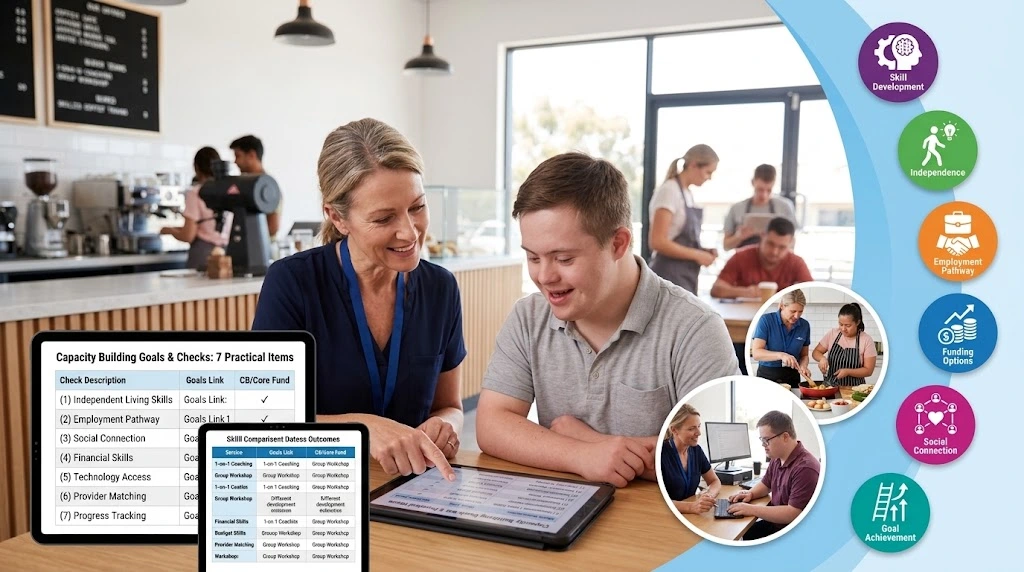

NDIS Support for Building Confidence can help people develop skills, try new activities, make choices and take part in everyday life. Confidence does not always appear quickly. For many people, it grows slowly when they have the right support, time and encouragement.
Confidence can mean different things to different people. For one person, it may mean preparing a simple meal without help. For another person, it may mean travelling on public transport, talking to someone new, attending an appointment or making a decision about their daily routine.
NDIS support can help participants work towards goals that matter to them. The NDIS explains that goals can include building skills, becoming more independent, joining social activities, working, studying and building relationships.
The important thing is that confidence should be built around the person’s own goals, needs and choices.
What Does Confidence Mean in Everyday Life?
Confidence is the feeling that you can try something, make a choice or deal with a situation. It does not mean that you will always feel comfortable or that everything will be easy.
A person can feel nervous and still be confident enough to try. For someone living with disability, everyday tasks can sometimes feel difficult. This may be because of communication needs, physical challenges, changes in routine, social situations or difficulty learning a new skill.
With the right support, a person can practice these activities at a comfortable pace. For example, someone may first need help making breakfast. After practicing the steps several times, they may be able to prepare breakfast with less assistance. Later, they may feel comfortable doing it on their own. This type of progress can help build confidence.
How NDIS Support for Building Confidence Can Help
NDIS Support for Building Confidence can be connected to many parts of everyday life. NDIS supports can help participants complete daily activities, develop skills, build independence and take part in the community.
The type of support a person receives depends on their individual needs and NDIS plan. Here are some common ways support can help.
1. Learning Everyday Living Skills
Everyday living skills are the small tasks people use throughout the day. These can include preparing food, getting dressed, organising belongings, following a routine, cleaning, shopping or planning activities.
A support worker can help a participant practise these tasks step by step. The goal does not always have to be doing everything without help. Sometimes the goal is to become more comfortable with a task or learn which parts can be done independently.
For example, a participant may learn how to prepare a simple lunch. A support worker might first demonstrate the task, then complete it together with the participant. Over time, the participant may take responsibility for more steps.
This can turn an unfamiliar task into something that feels easier and more familiar.
2. Building Confidence Through Small Goals
Big goals can sometimes feel overwhelming. Breaking a large goal into smaller steps can make it easier to understand and practise. The NDIS encourages participants to have both short-term and longer-term goals.
For example, someone who wants to become more independent with public transport might begin with:
- Learning the name of a local bus route
- Understanding where the bus stop is
- Practising reading a timetable
- Visiting the bus stop with support
- Taking a short trip with a support worker
- Practising the same journey again
- Eventually trying part of the journey with less support
Each small step gives the person an opportunity to practise. Completing small goals can also help a participant recognise their own progress.
NDIS Support for Building Confidence Through Daily Routines
A regular routine can make everyday activities easier to understand. Some people may feel more confident when they know what will happen next. A simple routine can provide structure for activities such as getting ready, eating meals, attending appointments and going into the community.
Support workers can help participants create routines that suit their needs and preferences. For example, a morning routine could include:
- Getting out of bed
- Getting dressed
- Preparing breakfast
- Taking required personal items
- Checking the day’s activities
- Getting ready to leave home
The routine can be adjusted as the participant becomes more comfortable. The aim is not to force everyone into the same routine. Each person’s routine should reflect their own lifestyle, needs and goals.
Why Small Daily Achievements Matter
A small achievement can be important. Someone who has always needed help preparing food may feel proud after preparing one meal with less assistance. Someone who has avoided social activities may feel more confident after attending a community activity.
These moments can encourage a person to try another step. Confidence often develops through practice rather than simply being told to “be confident.”
Building Social Confidence With NDIS Support
Social situations can be difficult for some people with disability. Starting a conversation, meeting new people, joining a group or asking for help may feel uncomfortable.
NDIS support can help participants practise social and communication skills where these supports are appropriate to their needs and plan.
NDIS therapy supports, for example, can include work on communication, social skills, interpersonal interactions and community living skills.
A participant might practise:
- Saying hello to someone
- Asking a simple question
- Explaining what they need
- Ordering food
- Speaking with staff
- Joining a group activity
- Taking part in a conversation
The person can practise these skills in real situations while receiving appropriate support. Over time, familiar situations may become easier.
How Community Participation Can Build Confidence
Getting involved in the community can give participants opportunities to practise skills outside the home.
Community participation may include visiting a library, going shopping, attending an activity, visiting a park, joining a social group or using public transport.
These activities can help a person practise decision-making, communication, travel and social skills.
The NDIS recognises that supports can help people take part in social and community activities when the support meets the relevant funding requirements.
A support worker may help a participant prepare for an activity, travel to the location and take part in the activity. The level of support can depend on the person’s needs.
Confidence Can Grow Through Repeated Practice
Doing something once may not be enough. A person may need to practise an activity several times before they feel comfortable.
For example, the first visit to a community centre may feel unfamiliar. The second visit may feel slightly easier because the person knows where to go. After several visits, the environment may become familiar.
Repeated practice can help turn a new experience into a normal part of everyday life.
How Support Workers Can Encourage Independence
A support worker can provide assistance while also encouraging a participant to make their own choices.
This can be important because too much help may prevent a person from practising their own skills.
Good support can involve finding the right balance.
For example, instead of doing every part of a task, a support worker may allow the participant to complete the parts they can safely manage.
A person may need help with one part of cooking but be able to choose the meal, collect ingredients and complete other steps themselves.
This approach can give the participant opportunities to practise skills while receiving help where it is needed.
NDIS Support for Building Confidence and Making Choices
Making choices is an important part of everyday independence. Choices can be simple.
A participant may choose what they want to eat, what clothes they want to wear, which activity they want to attend or how they want to spend their free time.
Support should respect the participant’s preferences and goals.
The NDIS states that participant goals are things they want to work towards and can include building skills, doing more things themselves, participating socially and building relationships.
Giving a person opportunities to make appropriate choices can help them become more comfortable expressing what they want.
How Support Coordination Can Help Build Confidence
Some participants may find it difficult to understand their NDIS plan or organise different supports.
Support coordination can help participants understand and use their plan, connect with providers and community services, and build confidence and skills in managing their supports.
A support coordinator may help a participant understand the services available to them and how different supports can work together.
This can be especially useful when a participant has several goals or different types of support.
The NDIS explains that support coordination is a capacity building support designed to help participants make the best use of their supports.
Building Confidence With Supported Independent Living
For some participants, Supported Independent Living, or SIL, may be part of their support needs.
SIL is designed for people who need support or supervision with everyday tasks in their home. The NDIS explains that SIL can include assistance with personal care, cooking, eating and household tasks, while also focusing on developing skills and independence.
Confidence can develop when a participant has opportunities to practise everyday tasks in their own home environment.
For example, a participant may work on:
- Preparing meals
- Cleaning their living space
- Following a daily routine
- Looking after personal belongings
- Making choices about activities
- Developing household skills
Support can be adjusted according to the person’s needs and abilities.
For more information about supported independent living, participants can also read the official NDIS information about SIL.
How Therapy Supports Can Help With Confidence
Some participants may receive therapy supports that focus on developing skills and independence.
The NDIS says therapy supports can help with everyday areas such as communication, personal care, mobility, social skills, decision-making and community living.
For example, an occupational therapist may work with a participant on functional skills needed for daily activities.
A speech therapist may help with communication and social interaction where appropriate.
These supports can help participants understand what they can do, practise skills and work towards their goals.
Therapy should be connected to the person’s needs and goals rather than being the same for everyone.
Confidence Does Not Mean Doing Everything Alone
It is important to understand that independence does not always mean doing everything without support.
A person can be independent while still receiving assistance.
For example, someone may use assistive technology, receive support from a worker or use another form of assistance to complete an activity.
The NDIS describes supports that can help people build independence and skills, including daily living supports, assistive technology and other supports that relate to their disability needs.
The goal is to help the person have greater choice and control where possible.
Sometimes independence means knowing when to ask for help.
How Families Can Support Confidence
Families and carers can play an important role in helping someone build confidence.
One useful approach is to recognise effort rather than only looking at the final result.
If someone is learning to cook, for example, completing one part of the meal may be a positive step.
Families can also give people enough time to make choices.
It can be tempting to step in and complete a task because it is faster. However, allowing a person to practise can give them an opportunity to develop their own skills.
Support should always consider safety and the person’s individual needs.
Families can also talk with the participant, support workers and other relevant professionals about their goals and progress.
How to Set Confidence-Building Goals
A good goal should be clear and connected to something the person wants to achieve.
Instead of having a broad goal such as “I want to be more confident,” it may help to identify a specific activity.
For example:
Broad goal:
“I want to become more independent.”
Specific goal:
“I want to prepare breakfast independently three mornings each week.”
Another example could be:
Broad goal:
“I want to become more confident in the community.”
Specific goal:
“I want to visit my local library with less support.”
Specific goals make it easier to understand what the participant is working towards.
The NDIS recommends thinking about what is important to you and using goals that can be short-term, long-term, specific or broad.
NDIS Support for Building Confidence Should Be Person-Centred
Every participant is different.
One person may want to learn cooking skills. Another may want to communicate more confidently. Someone else may want to travel independently or take part in community activities.
There is no single confidence-building plan that works for everyone.
Support should consider the person’s:
- Goals
- Strengths
- Preferences
- Support needs
- Communication style
- Daily routine
- Living situation
- Community interests
The NDIS also explains that funded supports must meet the relevant reasonable and necessary criteria. These criteria include being related to disability needs, helping with goals, supporting participation and being likely to be effective and beneficial for the person.
This means participants should discuss their individual needs and goals when planning their supports.
Signs That Someone May Be Growing in Confidence
Confidence does not always look like a big change.
Sometimes the signs are small.
A participant may begin to:
- Ask questions more often
- Make more choices
- Try an unfamiliar activity
- Speak up about what they want
- Complete familiar tasks with less help
- Join social activities
- Travel to familiar places
- Take responsibility for parts of their routine
- Ask for help when they need it
These changes can show that a person is becoming more comfortable with everyday situations.
Progress should be measured against the person’s own goals rather than compared with someone else’s abilities.
How Proteam Can Support Participants
At Proteam Group, support can be focused on helping NDIS participants live safely, comfortably and with greater independence.
Our NDIS disability support services can be connected to the individual goals and support needs of participants.
We understand that confidence can take time.
Our approach can focus on practical everyday activities, encouragement and respectful support. The aim is to give participants opportunities to develop skills while maintaining their choices, dignity and independence.
Participants may also explore services such as Supported Independent Living and other NDIS support options based on their individual needs and plan.